Friday, December 4, 2015

The Ocelot

The Ocelot

By Kelly Delaney


     The Leopardis Pardalis, commonly known as the Ocelot, was officially listed as and Endangered Species on March 28, 1972 due to immense habitat destruction, the use of the animal's fur and the high demand for the Ocelot as a domestic pet. Although most of these problems occur outside of the United States, the United States Fish and Wildlife Service is still doing everything it can to ensure that this animal remains successful on an international scale. 

About the Ocelot
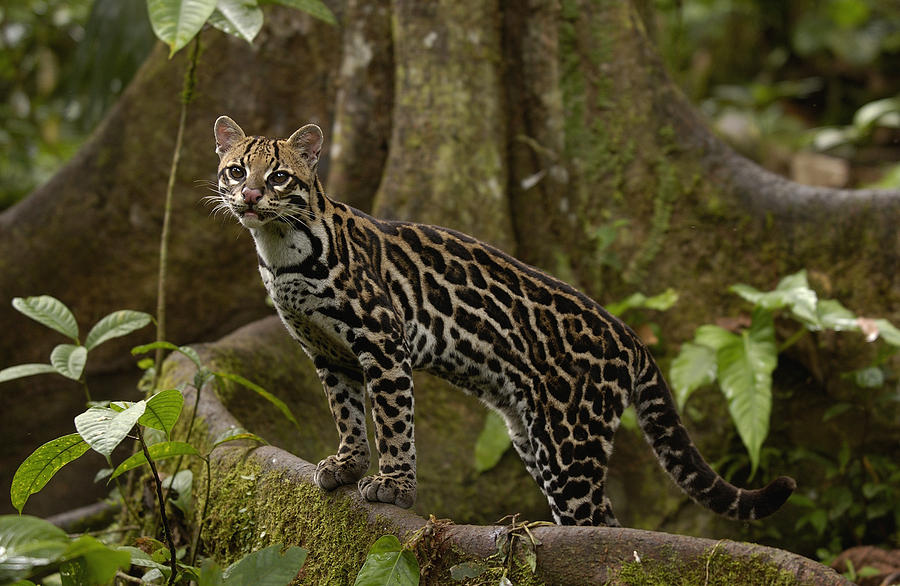
     The Ocelot is most well known for its intricate and fine fur which ranges in color from light yellow to red and is marked with dark brown rings and spots. Their fur is what makes them so popular among hunters and is a contributing factor to their steady decline as a species. They grow to be about 25 to 35 pounds and are about 30 inches long (National Geographic). To put this in perspective, they are about two times the size of a household cat. When kept in captivity the Ocelot can live up to 20 years and in the wild they live around 7 to 10 years (Defenders of Wildlife). The Ocelot is an extremely active nocturnal cat that can move up to 5 miles in a single night, catching about 3 meals in that time period (Defenders of Wildlife). Because the Ocelot is a carnivore, they tend to prey on animals such as rodents, reptiles, amphibians, rabbits, small deer and domestic livestock, their razor-like teeth make it extremely easy to rip though flesh while their rough tongues allow them to lick the bone clean, this is characteristic of most cats. Additionally, their main predators are coyotes, bobcats, wild dogs and of course, humans.

Habitat
     Ocelot's can be found throughout Central and South American regions that are north of Chile, small regions of the United States such as Arizona and Texas and on the border of Mexico. Ocelots tend to live under canopies in the South American rainforests where they can be covered by dense vegetation that offers them both protection and shelter, however, in the United States they live in brushlands that are often relatively close to residential areas (National Geographic). Because of this, Ocelots have been able to adapt to human habitats and can often have companionships with people, this leads into the Ocelot and their prevalence in the illegal pet trade. The map below shows different regions that the Ocelot may be found in. 


                                                                Source: http://www.theanimalfiles.com/mammals/carnivores/ocelot.html

Breeding
     Depending on where the female Ocelot is located, the breeding season may vary. For example, in Northern regions the breeding season occurs in autumn, yet in tropical locations, mating can occur throughout the year (National Geographic). The gestation period of an ocelot is anywhere around 79-85 days long and the litter can vary from 1 to 3 kittens. These kittens are born weighing about  3.2 ounces. Female ocelots reach sexual maturity faster then males at 2 years of age, while males are considered sexually mature at 2.5 years old. Once sexual maturity is reached, Ocelots tend to breed every other year ( The Animal Files).


Main Threats
     Like most other animals that are threatened or endangered, the ocelot is not only the visit of one human impact, but three. Although two of these three impacts mainly occur outside of the United States, the United States Fish and Wildlife Service is still doing as much as it can to help preserve the populations of Ocelots. Below are the three main causes of the Ocelots endangerment.

  1. Habitat Destruction
  2. Fur Trade
  3. The Exotic Pet Trade

  • Habitat Destruction: It is no surprise that the Amazon Rainforest is being destroyed for Agricultural purposes, thus destroying the homes of any Ocelots that inhabit the area. However, the area that is most vulnerable to habitat destruction is actually southern Texas, another area that a small proportion of Ocelots live. The rise of urban development and the implementation of freeway systems all throughout the southern hemisphere of Texas is causing a slow decline in the population of Ocelots and causing more and more deaths of the Ocelot by vehicle. One main criticism of the recovery plan put into place by the Fish and Wildlife Service is that they did not allocate enough land to provide a sustainable habitat for the Ocelot populations that live there (Biological Diversity). Additionally, acts are currently in progress to stop the hunting of Ocelots on the basis that they are a threat to the livestock industry. It is estimated that there are less than 100 Ocelots left in Texas (Wild Cat Conservation).
  • Fur Trade: Before habitat destruction became the main cause of the Ocelots endangerment, it was the illegal fur trade that initially wiped out Ocelot populations. Throughout Central and South America in the 1970 and '80s the fur trade reached an all-time high and nearly 200,00 Ocelots were killed annually for the use of their fur. Although laws have been put into place that have decreased this number dramatically, there is still a small demand for these furs and they can be purchased illegally for an extremely high price (Wild Cat Conservation).
  • The Exotic Pet Trade: Another cause of the Ocelot's peril is the demand for them as pets. In South America, many hunters still capture kittens by killing their mothers and sell them to tourists as pet. This problem is not as prevalent today as it used to be due to the fact that it requires a permit to transport Ocelots across border and there are so few remaining that hunters are even struggling to find them in order to sell them. 
Recovery Plan
     The recovery plan of Ocelots set forth by the United States Fish and Wildlife Service focuses mainly on the Ocelot populations that are inhabiting southern Texas. Within the next five years, they hope to reconnect the populations in Texas and Mexico in order to make one larger population that can move freely between the borders. They also hope to dedicate more land that will not be affected by the rapid urbanization of southern Texas and provide incentives to farmers and livestock owners not to kill Ocelots. The main goal at the moment is to delist the species or at least downgrade them from endangered to threatened. This can be done by improving the genetic fitness of Ocelots by expanding their populations and regions in which they inhabit and also by educating the public on ways in which they can help improve the quality and longevity of the Ocelot's life. 

Personal Action
     For my personal action I would write a letter to the Obama administration urging him to place tighter regulations and higher penalties on farmers that harm or kill Ocelots because they believe that they are threat to their livestock. Additionally I would ask that he or someone in his administration consider allocating more money to the United States Fish and Wildlife Service so that they are able to reconnect multiple populations of Ocelots. Another thing that could be done that would inform farmers that Ocelot's are not predators of livestock is to work on educating them on what is and what is not a threat to them. It is natural to be fearful of something that is not familiar, but if we educate the public and tell them the rick that Ocelot's are in of becoming extinct, it would be a giant step in removing Ocelot's of the endangered species list. 

What can we do?
  • A Symbolic Adoption: "Adopting" an animal can help provide funds to organizations that are trying to protect and preserve a certain species. Although you may not have personal contact with the animal, you can rest assured that you are doing something to help its survival. 
  • Write Government Officials: One action that can make a dramatic difference in the lives of animals is by writing government officials about problems that occur that affect wildlife populations. For example, there has been much criticism of the Obama administration about not addressing the killing of endangered Ocelots in Texas due to the belief that they are a threat to farmers income. Speaking up for animals who can not speak for themselves is a great way to ensure that action will be taken.
  • Stay Informed: Simply knowing that there are problems in the world that are devastating animal populations is a huge step in recognizing what you can do to make a difference. Once you are informed of the problems, you can spread the word and let people know how they can make a difference. 
Works Cited


Biological Diversity. "Saving the Ocelot." Biological Diversity website:
     http://www.biologicaldiversity.org/species/mammals/ocelot/

Defenders of Wildlife. "Basic Facts About Ocelots." Defenders of Wildlife website:
     http://www.defenders.org/ocelot/basic-facts

National Geographic. "Ocelot." National Geographic website: 
     http://animals.nationalgeographic.com/animals/mammals/ocelot/

United States Fish and Wildlife Service. Environmental Conservation Online System.
     "Ocelot Recovery Plan." August 22, 1990. United States Fish and Wildlife Service website:
      http://ecos.fws.gov/docs/recovery_plan/100826.pdf

Wild Cat Conservation. "Ocelot" Will Cat Conservation website:
     http://www.wildcatconservation.org/wild-cats/south-america/ocelot/

The Animal Files. "Ocelot". The Animal Files website: 
     http://www.theanimalfiles.com/mammals/carnivores/ocelot.html

Blue Whales


Blue Whales 
By: Joy Lomax


Description and Ecology

There is said to be about 5,416 different mammal species throughout the world. Out of all these different species, the gray whale has been known to be the largest mammal ever to roam the earth. These creatures are magnificent in their size, intelligence and way of communication. 

These whales can grow up to 100 feet long and end up weighing up to 200 tons which is equivalent to about 4 million pounds. In order to survive, these mammals eat tons and tons of krill every day. While these sea creatures may be called the “Blue Whales”, they truly only look blue under water, and on the surface they actually resemble more of a grayish tone. These whales usually cruise through the ocean at approximately 5 miles per hour and when aggravated, they can bring up their speed to about 20 miles per hour! 
Geographic and Population Changes

Blue whales can be found in the Southern Hemisphere, Northern Pacific, and Northern Atlantic. They also tend to migrate throughout the seasons so it is not rare for you to find these whales up north during the summer and farther down south toward the tropic, during the winter time. When they migrate and move thought the ocean that can travel alone, in pairs and even up to  groups of 60 whales together. 

They can be found anywhere from in the Southern Indian Ocean,  the coast off of Madagascar and all the way over to the Coast of Australia. They also can be found on the other side of the world close to Chile and up the coast of California as they migrate up north for the summer season. 

Listing Date and Type of Listing
Blue whales were protected from commercial killing in 1966 and then were finally listed in the Endangered Species Conservation Act before the Endangered Species Act was passed. When the ESA was passed in 1973, then blue whales were listed as endangered in the Marine Mammal Protection Act. 

Cause of listing and Main threats to its continued existence
There are several things in which blue whales are threatened by. Some of the main reasons why they are listed as endangered species is because the threats presented by the environment and by humans is causing a degradation for the livelihood of blue whales.  These mammals are threatened by chemicals, sounds pollution, habitat loss, loss of krill, ship strikes, and getting trapped in fishing nets. One main environmental problem that threatens blue whales is the climate change because it easily effects the the krill in the ocean by the global warming and also the increased amount of acidity in the ocean water. 

Lastly, some of the other main threats is that the frontal zones which is the area to which blue whales habitat and migrate is seen to be moving farther down south because of the climate change and result of global warming. In moving the frontal zones father south this creates complications to the blue whale species. They would have to move further in order to receive proper nutrient and sustain  themselves for years to come. Since multiple whales are moving south, this causes the whales to have to migrate farther down south to feed on krill. This in result cases more whales to move together down south which later affects the overall habitat value and creates competition amongst whales as they all search for food in order to survive. 

Description of Recovery Plan 
Since there are only about 5,000 blue whales left on the planet, it is important to consider what the recovery plan is and how to help the blue whales survive. One simple way is to limit the amount of human interaction that happens out in the ocean. This may include limiting the amount of whale watching amongst humans. We need to figure out how much whale watching affects the animals, and then limit our time spend out on the water. In addition to whale watching, we need to consider how much we are at rick of injuring the whales while fishing. The nets can be easily get caught on the whales allowing them to be trapped and potentially hurt. We need to determine where ship collisions occur with whale so that we can prevent it occurring in the future and also to track where the whales are so that the ships that we use do not pollute the environment surrounding the whales. 

Personal Action
We need to be aware at how we are all personally affecting the lives of blue whales. What can I personally do about the issue? While I may feel small in this world, I can still make a difference. Honestly, creating conversation with other people is going to be a huge contribution to getting the word out about blue whales. There are only 5,000 here left on earth and it would be amazing if we could help these giant mammals of the sea recover. So start a conversation with your classmates, your professors, family and friends. If you are a fisher, be aware of where you are fishing and keep into account where whales are during that season. Another big problem is that blue whales are being killed by commercial ships and one way to fix this is to open Navy Waters for commercial boats to sail through. The Navy has disagreed, and multiple people are writing a letter to Obama to encourage him to lead a movement to make an end to this tragedy. The link to write your letter is  https://secure.nrdconline.org/site/Advocacy?cmd=display&page=UserAction&id=3029  These creatures have so much to offer and we need to respect them and their intrinsic value to live freely in their own environment. 

References

Thursday, December 3, 2015

The Ocelot

by: Mariela Martinez

Background
Leopardus pardalis, commonly known as the Ocelot, a small feline but huge contributor to the Western hemisphere. Don't be fooled by its size they have pointed fangs used to deliver a killing bite, and sharp back teeth that can tear food like scissors. They have a beautiful fur coat that seems to be welcoming to cuddle with. And what about those captivating large round eyes, one can almost say they draw you in right? Well they are not just for looks, they allow them to see at night when they are most active. But enough sweet talk about this charming cat, it is time to get serious. This animal that we just described as appealing to the eye is in grave danger. In 1982 it was listed as endangered in the state of Texas and special concern in Arizona. What does that mean? It means that its population is decreasing, just like many other species listed under the Endangered Species Act. Although uncommon in California, it does not mean we should not worry about it, on the contrary we should help conserve it.


Geographic Ranges
Where can I find an ocelot, you may ask. Well my dear reader let me tell you where you can find one. Depending where you live is how far you may need to travel, in my case I am from California so I would need to pack my bags and book a trip to South of Texas and Arizona, Central and South America into Northern Argentina and Uruguay, which is where they are mainly found. Such an array of places right? Well, they do not have a prevalent preference on temperature since they can be found in tropical, pine, gallery, riparian and semi-deciduous forests, savannas, shrub lands, and marshlands. Their adaptiveness to different climates allow them to survive in almost any type of habitat but since they are sit and wait predators they do demand cover of at least 75%. Meaning that their habitat must be covered at least 75% by trees, shrubs, or grasses that will allow them to stalk their prey before they pounce and devour them. The only problem? Us.

Declining Numbers

No you did not read wrong, we are the problem of their population decline. We as humans are egocentric and possessive and like to think that this planet is ours and we can do as we please with it, but that is not correct. We live in a planet that we have to share with the rest of the species that inhabit it. Okay but how, what is it that we do that is causing this particular species to decline? For starters we are converting much of the habitat that they use for development and agriculture. Our obsession with expansion is what is causing habitat fragmentation and loss. This fragmentation is causing separation which can lead to inbreeding within the populations, and genetic drift. This is only part of it though, remember how I was talking about how good-looking this cat is, well so does the illegal fur and pet trade. Ocelots are also victims of this,  putting them in more danger and by who? Us, the humans. I do not mean to sound like negative Nancy but we are huge contributors to their decline. Now don't get me wrong there are people who do care and are actively doing something to maintain and recover the species.

Improving Ocelot Numbers

The ocelot recovery is monitored by the United States Fish and Wildlife Service (USFWS) in coordination with the Ocelot Recovery Program (ORP). These two organizations have an established recovery plan that if it goes as planned, the ocelot could be delisted by 2040. What is their plan you ask, let me tell a bit about this recovery plan. They have to start off by assessing the current status of the population, numbers, habitat conditions, geographic ranges and so on. Then comes the hard part, convincing humans to decrease the amount of development and negative effects they have on the population of the ocelots. From here USFWS and ORP will work on managing and even improving the genetic fitness and health of existing and future generations of this feline while reaching out to the public with information to educate them on how they too can be a part of this recovery. Me? Well I plan on being an educator of the ocelot. 

Let's Bring Back the Ocelot!
Yes you heard right, my plans for the future are to work at a zoo educating the public about species such as the ocelot that are in danger of becoming extinct. My passion for animals and education lead me to make this career choice. What if the zoo doesn't work out? I will reserve to option number 2, become a teacher at a high school teaching environmental science. What is that I hear? You want to get involved too? I have the perfect links for you dearest reader of mine. My all time favorite is blackjaguarwhitetiger.org where Eddie, the creator of this program focuses on the conservation of wild cats and has an ocelot. You can follow them on Facebook and Instagram as well and see his daily posts of all the great work he has done. There is also defenders.org which gives more information and facts about the different species that are also declining in size. Both websites allow for donations and have pages that give more information of how to get involved. I hope this blog post was able to inspire you to become more involved in the protection of wild species and makes you want to do more for their conservation so future generations are able to enjoy and appreciate the beauty of animals. Below in the reference section you can find more information on animal conservation in general and the ocelots. Now...LET'S BRING BACK THE OCELOT!


References
https://www.defenders.org/sites/default/files/ocelot-range-map-2.jpg
http://animals.nationalgeographic.com/animals/mammals/ocelot/
http://www.defenders.org/ocelot/basic-facts
http://blackjaguarwhitetiger.org
http://www.wildcatconservation.org/wild-cats/south-america/ocelot/


Wednesday, December 2, 2015

The Ocelot

The Ocelot

(Leopardus pardalis)
By: Alejandro Lopez


Description
The largest of the small spotted cats, the ocelot is the most recognizable cat species of the South American cats. These cats have sleek tawny yellow skin, sometimes reddish or grey, with blotched like spots that consist of a solid black outline with a dark yellow/brownish center. The underside is bright white with black spots, and the tail has black rings throughout its length.


Ecology
These cats are mostly nocturnal, spending most of the day resting in trees or in thick vegetation, while at night they hunt for their prey. The ocelot diet ranges from small rodents, to birds and reptiles (like iguanas, snakes and tortoises), to larger prey (like monkeys, deer, and armadillos). Unlike most cats, the ocelot doesn’t avoid water and is a good swimmer. Due to this their diet also expands into fish and crabs.

http://www.zooborns.com/.a/
6a010535647bf3970b0192ac94929d970d-500wi
When it comes to reproduction, the ocelot has a gestation period lasting about 70-80 days. With each gestation the female cat can yield anywhere from one to three kittens, averaging about 1.4. Breeding tends to happen year round in the tropics, while in other areas they tend to be more seasonal, usually in the fall and winter.

Distribution and Population
Ocelots occupy a wide variety of habitats, including tropical forest, coastal marshes, thorn scrub and savanna grassland. They have a large range, spanning from the US down to South America, with the exception of Chile.
http://maps.iucnredlist.org/map.html?id=11509

The ocelot used to range ­from Arizona to Arkansas but has been reduced to a small fraction in the most southern part of Texas. Although recently some ocelots have been seen in the southern most part of Arizona.

The population has been reduced dramatically in the US, leaving about 100 individuals in Texas. In other places, like Mexico, the ocelot is larger in population but is still relatively small with about 5.7 ocelots per 100 km­­2, roughly 2000 individuals. And in some South American countries the density reaches about 13.6 ocelots per 100 km2.

Main Threat and Listing

Known for its beautiful skin, the ocelot is a main attraction in the international fur trade. Due to the fur trade the ocelot was listed as an endangered species on March 28, 1972 by the US Fish and Wildlife Services. Although commercial hunting for the ocelot has begun to decline, due to improved legal protections, they are still being illegally hunted. Since the improvement of laws, the fur trade has now become a smaller threat behind habitat destruction. Like other species that live in tropical forest, deforestation has caused the survival of these luscious cats to be more difficult. Not only are there habitats being destroyed in the forests but in other regions their habitat is being demolished to create space for agriculture and/or cattle ranching.

Recovery Plan
Recently in August 26, 2010, the US Fish and Wildlife Services has made a recovery plan to help the ocelot out of the endangered species list. Currently the plan is still in the beginning stages with most of the action revolving around monitoring the species population and habitat in Texas. Using camera trapping surveys and radio tracking they are able to monitor the population size and also the cats that are arriving from Mexico. Another action that is being consulted is researching methods for translocating ocelots from areas of abundance to areas of limited population size, to help revitalize areas where the ocelot is on the verge of being extirpated.

Personal Action
Some ways to help out the ocelot include:
  • Visiting the Laguna Atascosa National Wildlife Refuge, one of the last places in the United States where ocelots can be found.
  • Support ocelots through the Adopt an Ocelot! Program. Fund are used for education, research, and habitat restoration for the ocelot.
  • Or get your very own ocelot license plate. These plates are $30, with $22 dollars going to the Laguna Atascosa National Wildlife Refuge.

https://rts.texasonline.state.tx.us/NASApp/txdotrts/
SpecialPlateOrderServlet?grpid=60&pltid=368


Works Cited

"Basic Facts About Ocelots." Defenders of Wildlife. N.p., 11 Apr. 2012. Web. 30 Nov. 2015. <http://www.defenders.org/ocelot/basic-facts>.

"Binational Ocelot Recovery Project." Binational Ocelot Recovery Project. N.p., n.d. Web. 30 Nov. 2015. <http://www.cooperativeconservation.org/viewproject.asp?pid=827>.

"The Endangered Ocelot." Ocelots at Laguna Atascosa National Wildlife Refuge. N.p., n.d. Web. 01 Dec. 2015. <http://friendsoflagunaatascosanationalwildliferefuge.org/Ocelots>.

"Ocelot Facts, Photos, Videos, Sounds and News." Big Cat Rescue. N.p., 15 Mar. 2015. Web. 30 Nov. 2015. <http://bigcatrescue.org/ocelot-facts/>.

"Ocelot." FELID TAG. N.p., n.d. Web. 30 Nov. 2015. <http://felid-tag.org/ocelot/>.

"Ocelot." Fun Facts about the. N.p., n.d. Web. 30 Nov. 2015. <http://www.thejunglestore.com/Ocelots>.

"Ocelot." International Society for Endangered Cats (ISEC) Canada. N.p., n.d. Web. 30 Nov. 2015. <http://www.wildcatconservation.org/wild-cats/south-america/ocelot/>.

"Ocelot (Leopardus Pardalis) Fact Sheet, 2011  ." Population & Conservation Status. N.p., n.d. Web. 01 Dec. 2015. <http://ielc.libguides.com/content.php?pid=661392&sid=5478093>.

"Ocelot Videos, Photos and Facts." - Leopardus Pardalis. N.p., n.d. Web. 30 Nov. 2015. <http://www.arkive.org/ocelot/leopardus-pardalis/>.

"Ocelots, Ocelot Pictures, Ocelot Facts - National Geographic." National Geographic. N.p., n.d. Web. 30 Nov. 2015. <http://animals.nationalgeographic.com/animals/mammals/ocelot/>.

Plan, First Pardalis) Recovery, and Revision. U.s. Fish And Wildlife Service, Southwest Region, Albuquerque, New M. (n.d.): n. pag. Web. 30 Nov. 2015.

"Species Profile for Ocelot (Leopardus (=felis) Pardalis)." N.p., n.d. Web. 30 Nov. 2015. <http://ecos.fws.gov/tess_public/profile/speciesProfile;jsessionid=0021914DEE975CAA8D909F71A14B05D1?spcode=A084>.


Gray Wolves

Gray Wolves
By: Kelly Martz

Eastern timber wolves aka gray wolves, or canis lupis, are majestic mammals that used to span almost the entire United States. Throughout the years, their numbers have been diminished greatly due to many different factors affecting the populations. To save these beautiful creatures, we have to understand these wolves and their tendencies.
Image result for grey wolf
http://hayday.wikia.com/wiki/File:European-grey-wolf--014.jpg


About the Eastern Timber Wolf
Timber wolves typically range from 80 to 100 pounds, but in some extreme cases they can grow to be up to 200 pounds (Gray). They are very advanced predators with bodies that are built to track prey and kill them efficiently. Their jaws are believed to have around three times as much biting power as the average canine (Gray). Gray wolves live in packs of around 7 to 8 members. The packs include the mother and father wolves, the alpha animals, their pups, and the grown offspring. The mother and father are the ones that hunt and track prey, choose dens, and establish the pack's territory (Basic). Packs typically inhabit an area of 20 to 214 square miles and tend to be territorial towards other packs in the area (Recovery). A wolf pack can be seen below.

Image result for wolf pack 
http://www.wallpaperaz.com/wallpaper/gray-wolves-norway-wallpaper-8175.html

Habitat
Eastern Timber wolves used to inhabit most of the United States, they were only not found in the southeastern region. As of now, they can only be found in the northwestern region, and in some parts of Minnesota and Michigan, which is only just a fraction of where they used to live. They do well in these areas because there is low density of humans. Below, you can see the current range of gray wolves in the United States compared to the area they used to inhabit.
http://www.biologicaldiversity.org/campaigns/gray_wolves/map2.html

Main Threats
The decline of the Gray Wolf population started a long time ago. According to Goldman (1944), the decline of the eastern timber wolf population in the United States was caused by six main factors.
  1. Intensive human settlement of the land
  2. Direct conflict with domestic livestock
  3. A lack of understanding about the animal’s ecology and habits
  4. Fears and superstitions about the animal
  5. Overzealous control programs designed to exterminate it
  6. Perceived competition for deer and moose.

Recovery Plan
Gray wolves are currently listed as “threatened” in Minnesota, and as “endangered” in the other lower 48 states. The goal of the plan is to recover the wolf population enough to reclassify them as just “threatened”. This plan was implemented in 1992 and had an estimated recovery date of 2005.This plan is specifically for the Minnesota, Wisconsin, and Michigan area. According to the recovery plan, this species cannot survive without large areas of wild land with a low density of humans and the availability of adequate prey such as ungulates and beavers. These criteria were best met in Minnesota, Wisconsin, and Michigan, so that’s why that was the area chosen for recovery. For a wolf population to be changed to “threatened” in Wisconsin, there must be a stable wolf population of 80 or more individuals for at least three consecutive years. For the wolves to be considered “recovered”, there needs to be two viable populations, one in Minnesota and one outside Minnesota. To reach this goal, several steps were taken. First off, the U.S. Fish and Wildlife services plan to increase public education on wolf restoration programs. Next, they are going to monitor wolf populations, their habitat conditions, and their prey. By monitoring the habitat, they will be able to maintain the proper conditions to sustain a larger population. Next, they will try to minimize the loss of domestic animals to wolves. Finally, when the wolves are making a recovery, they will contemplate possibly expanding the plan to New York. Hopefully, all those steps will be able to bring back the majestic wolf population (Recovery).

Personal Action
Since the recovery plan has been mostly successful, the U.S. has removed many of the protections that the Gray Wolves used to receive. They are now able to be hunted, which I do not think is right. There is a constant battle between conservation groups and court. Even though the populations have increased, they are have not been restored to their full potential, even though it was found that and increase would be beneficial to the ecosystem. There are groups that support protecting the wolves. For my personal action, I would join the center for biological diversity in their quest to help the wolves. I will join their volunteer network and keep up to date on opportunities to speak up and help these creatures.

Extra link to visit:


Works Cited
"Basic Facts About Gray Wolves." Defenders of Wildlife. N.p., 14 Mar. 2012. Web. 28 Nov. 2015.
"Gray Wolf." Wolf Facts and Information. N.p., n.d. Web. 28 Nov. 2015.

"Recovery Plan for the Eastern Timber Wolf."EASTERN TIMBER WOLF (n.d.): n. pag. U.S. Fish and Wildlife Services, 1992. Web. 27 Nov. 2015.